
Managing your email can lead to questions about storage and performance. If you’re a StanbroHosting customer using IMAP, you might face server resource usage issues. This is especially true if you have a lot of messages in your inbox.
When using IMAP, your email client syncs message headers from all emails in folders like your Inbox or Sent folders every time it checks for new mail. Having thousands of emails in these folders can make this synchronization process time-consuming and resource-intensive for the server.
Archiving your email is a great way to address these potential resource issues and keep your email account efficient. By moving older messages out of your main folders, you reduce the number of message headers that need to be synced regularly. This helps ensure speedy retrieval of new messages and prevents impact on server performance.
This guide will walk you through the steps you can take to archive your IMAP emails yourself, using methods supported by your StanbroHosting account.
Understanding IMAP and Archiving
First, let’s quickly recap how IMAP differs from POP3. With POP3, when you check your email, messages are typically downloaded and removed from the server, much like clearing out a physical post office box. With IMAP, however, a copy of the message remains on the server, allowing you to access your emails from multiple devices.
While this multi-device access is convenient, it means messages accumulate on the server over time. Archiving helps manage this accumulation.
Archiving can generally involve moving emails to a designated archive folder. This folder can reside either on the server (as an IMAP folder) or on your local computer (as a local folder). Storing messages in local folders directly on your computer can help reduce the disk space used by your email account on the server. Keeping primary folders like the Inbox below around 1,000 messages is recommended for efficiency.
Customer-Managed Archiving Methods
Here are a couple of ways you can archive your IMAP emails based on the options available:
Creating a Local Folder in Thunderbird
One way to archive messages and reduce server disk space is by creating a local folder directly in your Thunderbird email client. These folders reside on your computer.
Here are the steps:
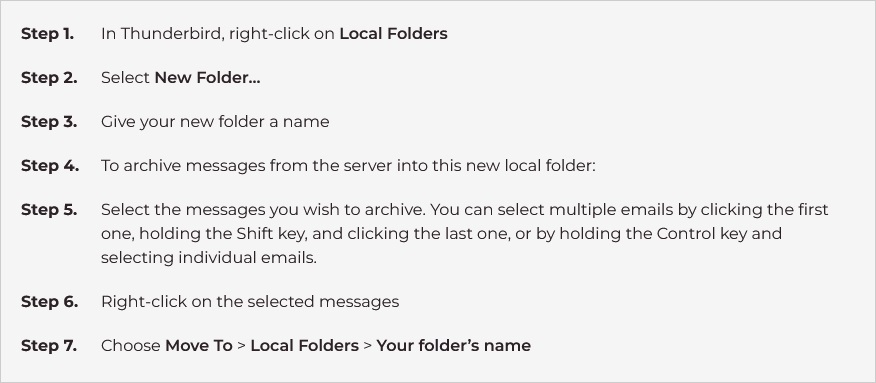
Moving emails to a local folder in Thunderbird means they are no longer stored on the Gmail server, for example. If you need to access old emails that were previously saved on your computer after reinstalling Thunderbird, you would typically need to reconnect your old email account to Thunderbird first, or somehow get the emails into an account accessible by Thunderbird, before you can store them in a local account.
Note that it is not possible to create a new main inbox folder within local folders. If you send a copy of a sent message to a local folder, it should remain there indefinitely. If you move messages to a local folder and they aren’t deleting from the original location as expected, they might disappear and then reappear.
Creating Server-Side IMAP Folders in Webmail or Other Clients
Another approach is to create archive folders directly on the server within your IMAP account structure. These are server-side IMAP folders. You can create these via your email client or one of the webmail clients available (like Horde or RoundCube). Once created on the server, you can subscribe to these folders from your email client.
While specific step-by-step instructions for creating these folders aren’t provided for all clients in the sources, the process is generally similar across mail clients. Here are the steps provided for creating an IMAP folder in Apple’s Mail application as an example:

You can make server-side IMAP folders in Horde and RoundCube. These folders will show up in clients like Gmail if it’s set up as IMAP.
Using server-side IMAP archive folders means messages stay on the server. This uses up your disk space. But, accessing these folders saves resources because they only sync when you click on them.
Moving Messages to Archive Folders
To move messages, whether to a local or server-side IMAP folder, it’s similar to Thunderbird. Just pick the messages and use the “Move To” function to send them to the archive folder.
Archiving messages moves them from one folder to another. To delete messages left in the original folder, you must do that separately. You can delete emails in Thunderbird by selecting them with the Shift or Control key.
Conclusion
Archiving IMAP emails helps keep your email account running smoothly. You can create local folders on your computer or server-side IMAP folders. This helps manage messages in your main folders.
By archiving old messages, you make your email experience better. It also helps avoid problems with using too many resources.
If you have more questions, or would like our assistance with archiving emails over IMAP, please open a ticket for our support team.